Traditional ryokan stays, atmospheric onsen streets, and some of Japan’s most restorative hot springs — all just a few hours from Tokyo.
TL;DR: Spend three slow days exploring the best of Gunma onsen, staying at two very different towns. Begin with Ikaho’s golden waters and nostalgic charm, then end in Kusatsu, home to one of Japan’s most powerful and dramatic hot spring sources. A refreshing alternative to overcrowded Hakone, offering authentic Japanese hospitality and true relaxation.
Table of Contents
Why Gunma Over Hakone?
Hakone is convenient, but it’s not the onsen experience you’re probably imagining.
Hakone sits just 90 minutes from Tokyo, which makes it the default choice for first-time visitors wanting to experience a traditional ryokan and hot springs. The problem is that everyone else had the same idea. The town is now so dominated by international tourists that many ryokans have lost their Japanese character entirely. English signage everywhere, staff catering primarily to foreign guests, dining rooms filled with tour groups — it works, but it doesn’t feel like the quiet, contemplative retreat that onsen culture is meant to provide.
Gunma’s onsen, by contrast, remains refreshingly local. Foreign visitors are still rare enough that you’ll likely be the only non-Japanese guest at your ryokan. The towns were built for domestic travelers, and they remain so. Not out of any deliberate exclusivity, but simply because foreign visitors haven’t discovered them yet. The pace is slower, the service more personalized, and the entire experience feels authentically Japanese rather than adapted for mass tourism.
The trade-off is distance. Gunma sits roughly two to three hours from Tokyo depending on your route — further than Hakone’s 90 minutes, and without a single convenient train line that takes you door to door. That extra friction is precisely why it remains uncrowded. I recommend committing to at least two nights across two different towns to make the journey worthwhile and to experience the range Gunma offers.
If you want convenience, choose Hakone. If you want an actual onsen retreat, choose Gunma.
Gunma Onsen 3-Day Route
Tokyo → Ikaho Onsen → Kusatsu Onsen → Karuizawa → Tokyo
Open in Google Maps via this link: https://tinyurl.com/yaekyn5j

Day 1: Arrival in Ikaho Onsen
A gentle introduction to Japan’s onsen culture
Ikaho Onsen makes an ideal first stop. Compact, walkable, and rich in atmosphere, it offers a soft landing into Japan’s bathing culture without feeling overwhelming or touristy.
The town’s history runs surprisingly deep. Ikaho’s hot springs were first discovered nearly 1,900 years ago, created by volcanic activity from the nearby Mount Haruna and Mount Futatsudake. But Ikaho as an organized onsen town didn’t emerge until much later in the 16th century, when seven samurai clans under the Takeda family recognized the potential of the sloping terrain and thermal springs.
What they built was remarkable: Japan’s first planned hot spring resort. They relocated the spring source to optimize flow, designed the town around the famous stone staircase, and created an ingenious system to draw and distribute hot spring water to designated residences and inns. This was a town intentionally designed for communal bathing and hospitality.
Ikaho is now best known for its distinctive golden-brown hot spring water, rich in iron. The source was first tapped over 500 years ago during Japan’s Warring States period, when these mineral waters were believed to help heal wounded soldiers. Today, the water still carries that restorative quality, though now it’s about healing urban stress rather than battle wounds.
That original layout still shapes Ikaho today. The town is built along a 365-step stone staircase, representing prosperity for each day of the year. Shops, cafés, and ryokans line the steps, creating an experience that’s tactile and vertical rather than sprawling. It’s a design that naturally slows you down—which is exactly the point, and has been since the 16th century.
The town remains largely unknown among foreign visitors, which means weekdays here are wonderfully quiet. You’ll share the streets with Japanese domestic tourists and locals, but rarely feel crowded. Even the famously popular Hanayama flat udon restaurant (which usually draws long queues in Tokyo) had no wait when I visited.
Getting there via public transport
Option 1 (Direct Bus)
Tokyo → Ikaho Onsen (approx. 3 hours 10 minutes)
Option 2 (Train and bus)
Tokyo → Takasaki by Shinkansen (45 minutes)
Takasaki → Shibukawa by limited express train (15 minutes)
Shibukawa → Ikaho Onsen by bus (20 minutes)
Getting there via rental car (recommended)
I suggest renting a car from Shibukawa Station rather than Tokyo. It gives you flexibility to explore the region while avoiding the stress of navigating out of the city. Ikaho Onsen is a 15-min drive from Shibukawa. Get to Shibukawa with the following transport:
- Tokyo → Takasaki by Shinkansen (45 minutes)
- Takasaki → Shibukawa by limited express train (15 minutes)
Bonus tip: On the way from Shibukawa, stop at the Ikaho Toy Doll and Car Museum, an unexpectedly delightful collection ranging from teddy bears and traditional dolls to retro gaming consoles and classic Japanese cars. Fun for kids and adults alike. Not to be missed for fans of “Initial D”, a manga and anime series about street racing set in Gunma.
What to Do in Ikaho
After arriving, slow down immediately. Check into your ryokan, change into a yukata (the traditional robe provided), and give yourself permission to do very little.
Stroll the iconic stone stairway in the late afternoon, when the light softens and the town takes on a nostalgic glow. Small shops sell local crafts, traditional sweets, and onsen-themed souvenirs.

At the top of the steps, you’ll reach Ikaho Shrine, dedicated to the deities of hot springs and medicine. The views from here stretch across the town and surrounding valley. It’s a fitting place to pause, breathe, and reset before heading back down.

Stop for udon at Hanayama. In Tokyo, this is the restaurant with the two-hour queue. The Ginza location regularly has people lined up at the door before service even starts, and social media hasn’t helped — the flat udon has gone properly viral. The original location is right here in Ikaho, roughly two-thirds of the way up the stone stairway, just across from the Fukuichi ryokan’s exit. Easy to spot once you know where to look; easy to walk straight past if you don’t.
The flat udon is the thing to order — wide, glossy ribbons with a satisfying chew that holds up beautifully to the dipping broth. Around ¥2,000 for a udon set. Simple, considered food done with real care. It’s the kind of lunch you’d travel for on its own, which makes finding it here, between stone steps and steaming bathhouses, feel like an especially good secret.

Back at your ryokan, enjoy your first soak in Ikaho’s golden-colored onsen waters. The iron content gives the water its distinctive rust-brown hue and a slightly mineral taste if it touches your lips. The color might look unusual if you’re new to onsen, but it’s deeply relaxing, it’s the kind of soak where tension genuinely melts away.
Where to Stay in Ikaho
Ikaho has two main onsen sources: golden water (kogane-no-yu) and silver water (shirogane-no-yu). I highly recommend choosing a ryokan supplied by the golden water because it’s the older, more historic source that defines Ikaho’s character and has been enjoyed for centuries.
Not every ryokan in Ikaho has access to the golden water, so this is worth checking before booking. When researching accommodations, look for mentions of 黄金の湯 (kogane-no-yu) in the property description.
I tried both the golden and silver water during my stay. The golden water felt more special. Though not because of any noticeable difference in therapeutic effect, but because of its history and uniqueness. The color, the iron-rich scent, the knowledge that warriors once soaked in these same waters — it adds a layer of meaning that enhances the experience.
I stayed at Kaichoro, the sister property of the well-known Ikaho Fukuichi. It sits at the luxury end of the spectrum with exceptional service, and rooms with private onsens that feel genuinely special rather than merely decorative.
The food was the other highlight. Kaiseki dinner isn’t a fixed menu as dishes rotate with the season, so I won’t describe specific courses that may not exist by the time you visit. What I can say is that each course felt considered rather than composed for show: small portions with clear intention, flavors that built on each other rather than competing. The kind of meal where you slow down without deciding to. Breakfast the next morning follows a similar structure — lighter, but equally thoughtful.
One thing worth knowing before you book: Kaichoro’s private in-room baths draw from the silver water, not the golden. The golden water is available in the shared onsen facilities in the sister property, which are well-appointed and easy to access, but you won’t have it to yourself. The golden water’s relative scarcity is precisely why private access to it is so rare across Ikaho. What Kaichoro delivers instead — the room itself, the attentiveness of the staff, the food — fully justifies what you’re paying. The onsen is one part of the experience. Here, every other part is exceptional.
My recommendations: I liked staying close to the stone stairways for easy exploration and I would definitely choose a ryokan with the golden water available.
Luxury: Kaichoro (https://kaichoro.net/)
Mid-range:
- Personalized service at a good price point: Chigira Jinsentei (https://jinsentei.com/)
- Large, well-known: Fukuichi (https://www.fukuichi.jp/)
- Historic, mid-sized: Moriaki Ryokan (https://www.moriaki-ikaho.co.jp/)
- Atmospheric, intimate: Kishigon Ryokan (https://www.kishigon.co.jp/)
Day 2: From Ikaho to Kusatsu Onsen
Deeper into Gunma’s onsen heartland
Where Ikaho is intimate and nostalgic, Kusatsu is larger, livelier, and entirely built around hot spring culture. Frequently voted Japan’s number one onsen town by Japanese travelers, Kusatsu is renowned for having the highest hot spring output per minute in the country — an astonishing 32,000 liters of naturally heated water flowing from the earth every single minute.
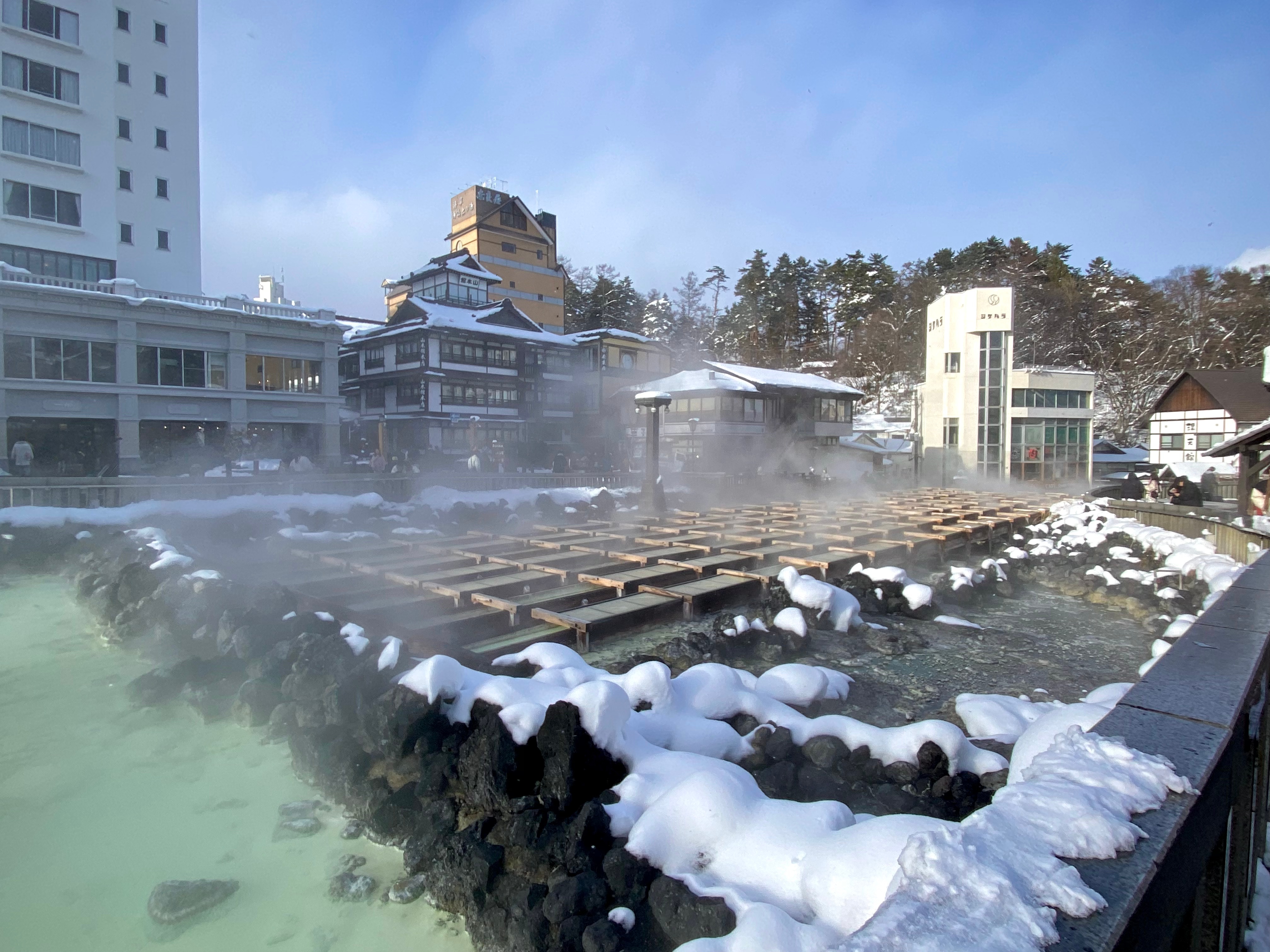
The town centers on the Yubatake (literally “hot water field”), a dramatic wooden structure where steaming, sulfuric spring water gushes into channels before being distributed throughout the town. This is Kusatsu’s beating heart, and it’s impossible to miss.
The first thing you’ll notice when you arrive is the smell. The moment you step off the bus or out of your car, the air hits you with a sharp, sulfuric scent — some describe it as rotten eggs, but I find it strangely appealing, a reminder that you’re standing above an active geothermal system. The smell permeates the entire town. You get used to it quickly though, and by the end of your stay, it becomes part of the atmosphere.
The Yubatake itself is mesmerizing, especially in winter. Steam rises constantly from the hot water, shrouding the wooden channels in mist. When temperatures drop, the contrast between the scalding water and freezing air creates an almost ethereal scene with clouds of vapor glowing under street lights, the scent of sulfur mixing with cold mountain air. I visited in winter, and the atmosphere was unforgettable.
Despite its fame, Kusatsu maintains a strong local identity. Foreign tourists are still relatively few, though the town is very well-known among Japanese travelers and can get quite busy on weekends. The car parks fill up with day-trippers, but evenings quiet down once visitors head home, leaving overnight guests to enjoy the town in peace.
Getting there via public transport
There are three legs to the journey as Kusatsu is located deep in a mountain valley.
- Ikaho → Shibukawa by bus (20 minutes)
- Shibukawa → Naganohara by local train (1 hour)
- Naganohara → Kusatsu by bus (30 minutes)
Getting there via rental car (recommended)
The drive from Ikaho to Kusatsu is around 1 hour 15 mins.
Bonus Detour: Take a scenic route through Mount Haruna. Stop at Lake Haruna, a caldera lake perched at the mountain’s summit. Activities vary by season, including canoeing in summer, ice fishing in winter. Then visit Haruna Shrine, one of Gunma’s most atmospheric spiritual sites. The shrine is tucked deep in the forest. Quiet, mossy, and almost mystical, it feels entirely removed from the modern world. The approach itself is meditative — stone lanterns, weathered torii gates, the sound of water trickling over rocks. It’s a place that rewards slow exploration.
What to Do in Kusatsu
Visit the Yubatake, ideally multiple times during your stay. The scene changes throughout the day from morning light cutting through steam, to afternoon crowds gathering around the edges, to evening glow under lanterns. Walk the wooden platforms that bring you closer, feel the heat radiating from the water, breathe in the sulfur-heavy air.

Watch (and participate in) a yumomi performance. This is a traditional method of cooling Kusatsu’s extremely hot spring water (which emerges from the ground at nearly 90°C or 190°F) without diluting it. Performers use large wooden paddles to rhythmically stir and splash the water while singing folk songs. It’s theatrical, oddly hypnotic, and deeply rooted in local tradition.

Performances are held several times daily from mid-morning at Netsunoyu, adjacent to the Yubatake. The exact schedule varies by day of the week and month, so check the board when you arrive rather than planning around a fixed time. Entry is around ¥700 per person, you can buy tickets in person on the day.
A performance lasts about 30 minutes, and audience members are often invited to try stirring the water themselves. It’s harder than it looks — the paddles are heavy, the rhythm specific, and the heat from the water can be felt even from a distance.

Take an evening walk through the town after dinner. This is worth doing even without a destination. Once the day-trippers have gone, Kusatsu quiets down considerably because most shops and restaurants close early, and the streets empty out. What’s left is the town at its most unguarded: steam rising from grates in the road, the sulfur smell sharper in the cold air, the Yubatake glowing softly under its lights with no crowd around it. It’s not an evening of nightlife. It’s twenty minutes of quietly appreciating where you are.
Where to Stay in Kusatsu
When choosing a ryokan in Kusatsu, prioritize properties that draw water from the main onsen source connected to the Yubatake. This is the heart of Kusatsu’s hot spring system — the same intensely therapeutic water that has made the town famous for centuries.
The water itself is powerful: high in sulfur, with temperatures close to 90°C at the source, and a pH level acidic enough to have natural antibacterial properties. It’s prized for skin conditions, circulation, and general well-being, though the real benefit is simply how deeply relaxing it feels.
Not every hotel in Kusatsu has access to this main source. Some properties use water from secondary springs or even heated tap water. The difference is significant, both in experience and authenticity. I stayed at Naraya, the higher-end option in town. It’s a well-run property — comfortable, well-located near the Yubatake, and the onsen facilities are excellent. It didn’t reach the heights of Kaichoro, but it’s also considerably less expensive, and for Kusatsu, it’s among the best the town offers.
High end: Naraya (https://www.kusatsu-naraya.co.jp/)
Mid-range:
- Large, well-established: Hotel Ichii (https://www.hotel-ichii.co.jp/)
- Elegant, local favourite: Kusatsu Onsen Hotel Sakurai (https://www.hotel-sakurai.co.jp/)
Day 3: Return to Tokyo via Karuizawa
A relaxed return with fresh air and good food
After breakfast at your Kusatsu ryokan, head toward Karuizawa, an upscale mountain resort town that serves as an excellent midpoint on the way back to Tokyo. Rather than rushing straight home, this stopover lets you stretch your legs, enjoy a change of scenery, and end the trip on a lighter, more leisurely note.
Karuizawa has long been a summer retreat for Tokyoites seeking cooler air and open space. It’s polished, well-maintained, and unexpectedly cosmopolitan for a mountain town. There’s genuinely something for everyone here: nature walks for those who want to stay outdoors, boutique shopping for those ready to return to civilization, and an eclectic dining scene that offers both traditional Japanese cuisine and Western options if you need a break from kaiseki.
Getting there via public transport
Kusatsu → Karuizawa by bus (approx. 1 hour 25 minutes)
Bonus Tip: Store your luggage at Karuizawa Station and rent a bicycle to explore. Many of the town’s attractions are spread out (say a 45-50 minute walk between points) making cycling the most efficient and enjoyable way to get around.
Getting there via rental car
The drive from Kusatsu to Karuizawa is around 1 hour.
Bonus Stop: On the way, visit Shiraito Falls, a wide, gentle cascade that’s particularly beautiful in late spring and autumn.
What to do in Karuizawa
Take a short nature walk. Karuizawa is known for its ponds, waterfalls, and forested trails, and Kumoba Pond is one of the most rewarding stops. Fed by the exceptionally clear waters once reserved for imperial use, the pond is mirror-still on calm days, reflecting larch trees and maple leaves so vividly it feels almost unreal. The scenery changes dramatically with the seasons: fresh alpine greenery from spring through summer, brilliant autumn foliage, and snow-covered stillness in winter. A well-maintained loop trail of about 1km circles the pond, ideal for an afternoon stroll. Benches along the water invite you to sit, pause, and simply take in the landscape.

Relax at Café Maruyama, the original flagship of one of Japan’s most influential specialty coffee roasters. Since the early 2000s, Maruyama Coffee has practiced direct sourcing, which means traveling personally to growing regions to select beans. This approach helped shift Japan’s coffee culture well before that became standard. In 2014, a barista trained here became the first Asian to win the World Barista Championship.
I had a flat white. The beans change frequently, so what you get will depend on the season, but the sourcing philosophy means the quality is consistent even when the flavour profile isn’t. Fragrant, balanced, no sharpness. The kind of coffee that makes you stay longer than you planned, which in Karuizawa is no bad thing.

Enjoy a leisurely lunch. Karuizawa’s dining scene is eclectic and genuinely good. You’ll find everything from traditional soba shops to French-inspired bistros. After two nights of kaiseki, this is your chance to eat something completely different if you’re craving variety. If you have a car or a bike, head to Harunire Terrace for lunch. It is an open-air complex of restaurants, cafés, and shops set along a wooden boardwalk among the trees. The mix runs from traditional Japanese to Western options, and the setting is quietly lovely. Otherwise dine at Old Karuizawa Ginza Street for easier access on foot.
Browse boutiques and local shops, from artisan bakeries, handmade jewelry, specialty food stores. Karuizawa has the quiet confidence of a European alpine resort (think Cortina d’Ampezzo or a refined village in the French Alps) translated into a Japanese context. Streets are made for strolling, not ticking off sights, and it’s most enjoyable when you let curiosity lead the way.

Getting back to Tokyo
Karuizawa → Tokyo by Hokuriku Shinkansen (1 hour 10 minutes)
If you rented a car, I recommend returning it at Karuizawa Station and taking the Shinkansen back to Tokyo. The train is faster, runs frequently, and eliminates the stress of driving into the city. It’s the most efficient way to end the trip.
Practical Notes
Should You Rent a Car?
I rented a car, and I’d recommend it if you’re comfortable driving in Japan.
A car gives you flexibility to visit sites like Haruna Shrine and Shiraito Falls, stop at hidden lunch spots, and move between towns on your own schedule. Parking is available at virtually all ryokans and attractions in Gunma, and traffic is minimal compared to urban areas.
That said, this Gunma onsen itinerary is entirely doable via public transport. Buses and trains connect all the main stops, and many travelers prefer not dealing with a rental car. The trade-off is less spontaneity and slightly longer travel times, but it’s a perfectly valid choice.
Budgeting for a Gunma Onsen Trip
Rough transport costs (approximate, subject to change):
- Tokyo → Shibukawa by Shinkansen: around ¥4,000
- Karuizawa → Tokyo by Shinkansen: around ¥6,000
- Local and regional buses (each leg): typically ¥1,000–¥2,000
If you’re doing the full route by public transport, budget roughly ¥14,000–¥16,000 for transport across the three days.
Gunma onsen offers ryokans across a wide range of price points, but as a general guide — and noting that prices shift with seasons and weekends — expect to pay roughly:
- Mid-range: Around ¥25,000 per person per night, including thoughtful dinner and breakfast
- High-end: ¥40,000–¥50,000+, private baths may be available, more personalized service, and elevated cuisine
- Luxury (e.g. Kaichoro): ¥75,000+ per person, expect private in-room onsen, highly attentive service, exceptional seasonal menus with luxury ingredients
These are approximate figures for weekday stays. Weekend and Japanese public holiday rates are noticeably higher — sometimes significantly so. If your dates are flexible, a midweek visit is the most cost-effective choice and also the quieter one.
When booking, confirm:
- Which onsen source the ryokan uses (golden water in Ikaho, Yubatake source in Kusatsu)
- Whether meals are included (most traditional ryokans include both dinner and breakfast)
- Room type and bath access (private vs. shared onsen)
When to Visit Gunma’s Onsen Towns
Gunma is excellent year-round, but each season offers something distinct:
- Autumn (October-November): Ikaho is particularly beautiful with fall foliage. Pleasant temperatures, fewer crowds.
- Winter (December-February): Kusatsu is at its most dramatic. Steam against snow, crisp mountain air, fewer tourists. My personal favorite season.
- Spring (March-May): Cherry blossoms and fresh green landscapes. Comfortable weather for exploring.
- Summer (June-August): Warm but not oppressive thanks to the mountain elevation. Good for pairing onsen with outdoor activities.
Weekdays are quieter across both towns. Weekends, especially in Kusatsu, draw more domestic tourists and day-trippers.
Final Thoughts
Gunma doesn’t ask much of you. It asks that you slow down, that you give the ryokan experience the time it actually needs, and that you resist the urge to treat it as a box to tick on a broader Japan itinerary.
In return, it gives you something Hakone stopped offering a long time ago: the feeling that you’ve actually arrived somewhere. Two towns, two distinct personalities, two kinds of hot spring water, and a route that flows naturally without backtracking or rushing.
If this is your first onsen trip, Gunma will set a standard that’s hard to match. If it’s not your first, you’ll know immediately why you chose well.
Planning a visit to Japan beyond the obvious? Japan beyond the Golden Route maps out the best side trips from Tokyo if you’re building a longer trip.
Leave a Reply